Wednesday, June 28, 2006

The Penultimate Street Shooter?

Summary

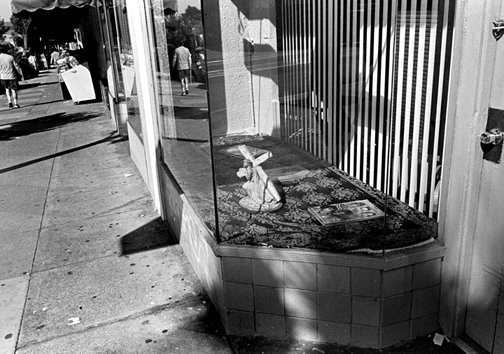
I’ve been shooting with the Hexar AF for about 2-3 weeks, and I think that I’ve been able to get a pretty good feel for the camera. Although it has some minor aggravations, the Hexar AF is an exceptional street-shooting camera. It’s discrete, easy to use, has a great lens, with an accurate light meter, and a quick auto-focus. Above all else, it is a "real" camera, with that "real" camera feel. A worthy tool, worthy of consideration by someone who considers himself (or herself) a photographer.

The Hexar AF
My version is the early black model, so it has the “stealth,” silent, or more precisely, low-volume mode. This was the feature (along with the black finish) that led me on to wanting to shoot with the camera; stealth is a desirable quality for me. The silent mode isn’t exactly silent. You can hear the camera’s AF and film advance, if you listen carefully and closely, in a quiet location. Outdoors, and on the street, where the natural din is always present, it’s virtually a silent, black camera, and therefore, stealthy.
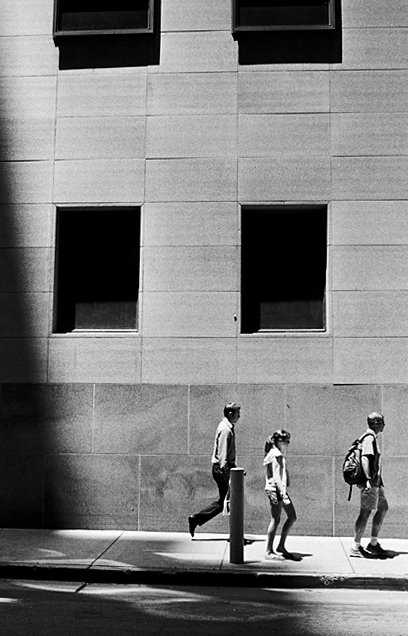


As I mentioned, the camera has both auto-focus (AF), and auto film-advance. Neither feature was a selling point for me, because they both pushed the camera toward the dreaded point-and-shoot category. I love cameras that are manually operated. My acceptable limit for automation is an internal meter and auto-exposure capabilities; both of these features are present on the Hexar AF, by the way. The thought of shooting with the AF and auto film advance initially offended my sensibilities. However, I came to appreciate both features as very nice additions for shooting on the street.

Here’s what’s sweet about the Hexar AF

Silent Mode
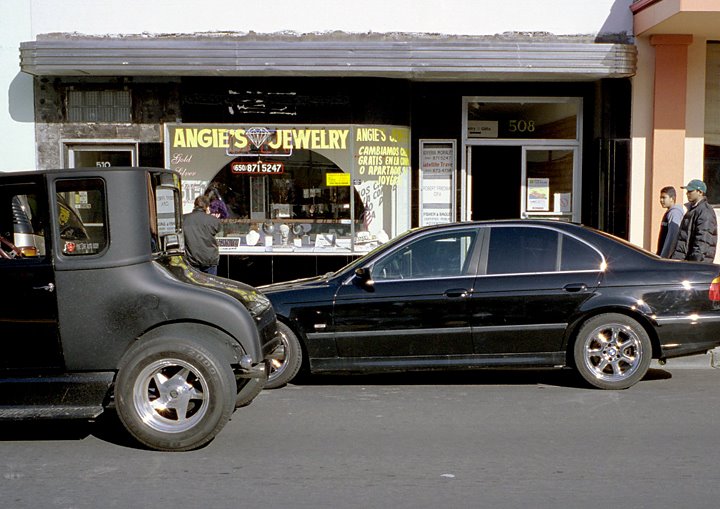
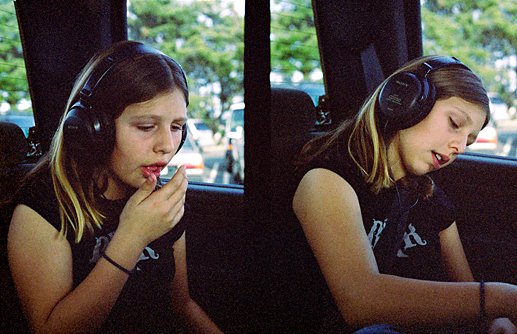
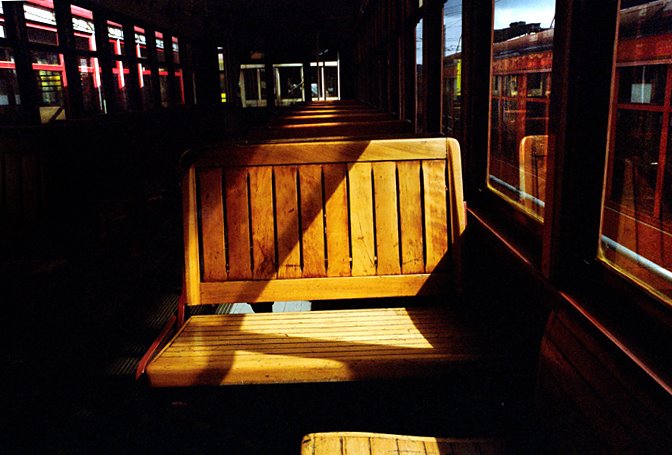
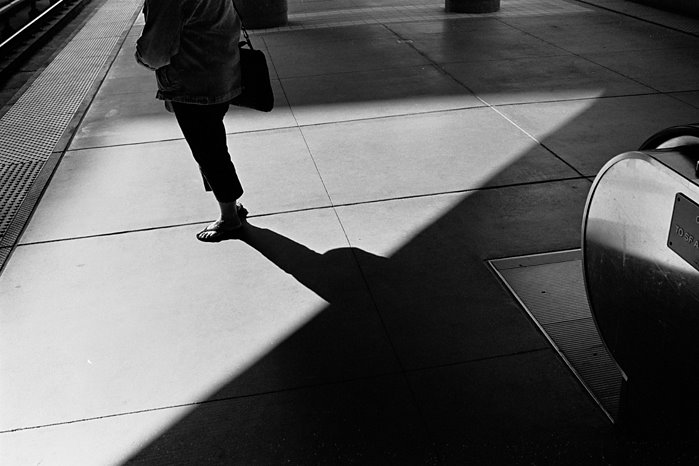
This is just plain cool; but why? Does it make a difference, on the street, where the din can conceivably drown out the sound of the loudest of cameras? Yes, it does make a difference. I’ve been carrying with me, along with the Hexar AF, a Fuji Natura S, which is a true p&s that is about half the size of the Hexar. It is easily twice as noisy, and there is no way I could have taken shots such as this one with the Fuji and not made a spectacle of myself.
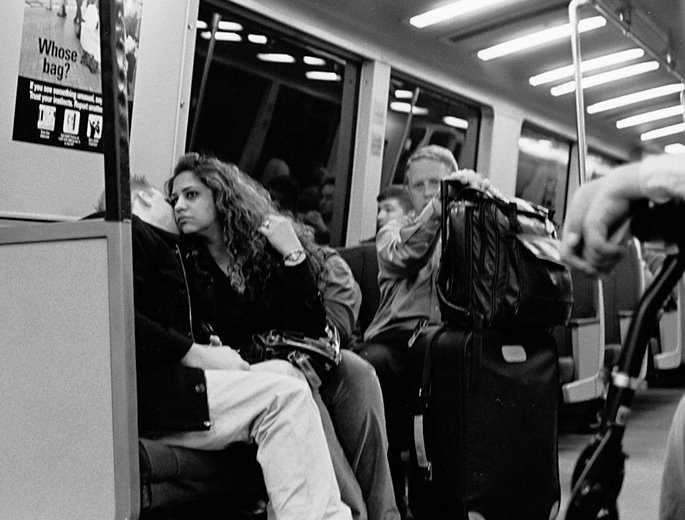


Turning the Fuji on would have been like ringing a bell on this train. Auto-everything cameras have a very distinctive sound. I booted up the Fuji while standing on a quiet train station platform, and people as far away as 40 feet heard the noise and looked my way. I booted the Hexar AF into low-noise mode, at the exact same location, just prior to turning on the Fuji, and not a single person noticed. On the street, even with the din, this can mean the difference between taking one or more additional shots of a scene, as opposed to just getting a single shot off. I’m sure my tank-like Leica M4-P, with its cloth shutter, is just as silent, if not quieter, so why not just shoot with it?

For me the answer is simply a matter of the convenience of size, as well as the quality of the compromises the Hexar brings to the table. I’ve been shooting while on lunch breaks at work. I take the Hexar with me to work on the train in my soft briefcase.
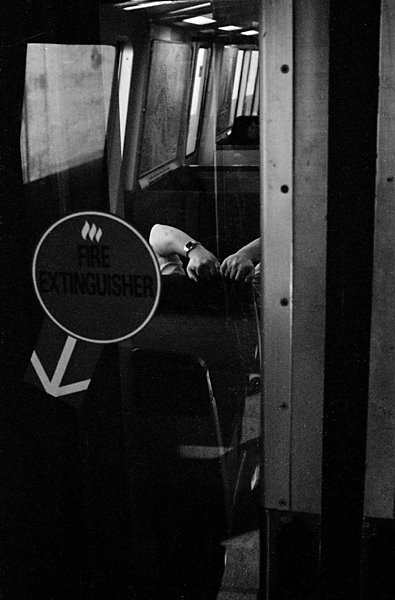


I wear a thin wind-breaker jacket, and when I need it to, the camera fits easily into the jacket’s side pocket. Additionally, the camera offers an excellent compromise between the quality of my M4-P and the array of lenses I own. The lens is no slouch, which brings me to…


Lens 35/2 w/a Built-in Hood
With the Hexar I get a sharp high-quality fixed 35/2 lens, with a built-in lens shade. The 35mm focal length is excellent for shooting on the street.


From what I’ve been seeing the lens is easily on par with my Cosina Voigtlander 35/2.5 lens, but probably not as contrasty as that lens. It’s a different signature that my capabilities can’t define. I might put it near the CV 35/1.7, but I still need some time with the camera to make those kinds of direct detailed comparisons.


Auto-Focus/Auto Film Advance
Without a doubt, auto-focus and auto film advance increase shooting speed. Pulling rapid hip, or quick-shots is no problem.


The Hexar also boots quickly, focuses rapidly, and has a long ‘on-time.’ When it does go into sleep mode (after a couple of hours), it reawakens rapidly with a slight probe of the shutter release. With the AF the photographer can hold the focus by maintaining pressure on the shutter release—after the AF locks. That’s a nice intuitive feature.


Manual Exposure Mode/f-stop Dial and Meter
There are three exposure modes on the Hexar: P (program) mode, A (aperture-priority) mode, and M (manual) mode. I rarely used the A mode, and seldom used the P mode. The M mode is a great way to shoot with this camera. The large f-stop dial on top of the camera protrudes just far enough, towards the front of the camera, that moving it while viewing through the camera is very easy. Once you’re use to the direction, adjusting exposure is a breeze. The camera has ‘+’ and ‘-‘ indicators in the viewfinder, as well as a green in-focus dot, 35mm framelines, and a small (almost useless?) sliding focus scale. To obtain correct exposure the photographer must obtain both a ‘+’ and a ‘-‘.

The meter, btw, is excellent, and like the AF the exposure, when in P mode, can be held, so the photographer can obtain a reading from the shadows (for example) and then readjust the framing. When doing this, it’s important to keep in mind that you’re also holding the focus. What I do instead, while in M mode, is assess the light (either visually, with the camera's built-in meter, or with a handheld meter), set the shutter speed, and adjust the f-stop. I’ll use the camera’s meter to take range readings, noting shadow and highlight.


I’ve gotten some excellently exposed negatives using both the P mode and the M mode. The meter is great for taking averaging readings. By pointing the camera at an open scene, and taking a light reading, you can get very accurate readings.


Here’s what is not so sweet about the Hexar AF

Too Quiet?
Can it be that silent mode is too silent? Yes, sometimes. It seems that sometimes silent mode is so effective that occasionally I’ll have to check to make sure I actually took a picture, and the little display window doesn’t easily cooperate with that task, preferring to cycle between the shutter speed (remember, I shoot in M mode) and the frame number. So, there’s always this little delay of about a second or two wherein I have to keep an eye on the little window to verify the frame advance.

Exposure Indicators are Hard to See Outdoors in Bright Light
The ‘+’ and ‘-‘ indicators located at the bottom of the viewfinder can be difficult to see outdoors, and usually are most effective when the camera is pointed toward a dark scene. This can be very frustrating, and puts a damper on using what is an excellent meter.

Top Shutter Speed is only 1/250
This is almost a deal-breaker for me. This is just too way too slow. I like a top speed of at least 1/1000, and I’d love to shoot with the AF’s cousin, the RF, a camera with a top speed of 1/4000.

Small Buttons and Cryptic Menus
The small buttons and cryptic menus are well known “characteristics” of this camera. I’ll only address the fact that adjusting shutter speed, though easy, is much easier on other cameras. Adjusting shutter speeds should not take all your attention to achieve. Like the f-stop dial on this camera, changing shutter speed should something you can do without taking the camera down from your eye. However, with a top speed of 1/250, and shooting on the street, you’ll probably seldom what to change the shutter speed anyway.

Conclusion
The Hexar AF is a joy to use. As a small stealthy street shooter, I doubt it can be beat. While technically a point & shoot, the Hexar when operated in M mode feels like a “real” camera. As someone who categorizes himself as a photographer, I’ve never felt diminished shooting with this camera. A co-worker saw my camera sitting on my desk, and picked it. She knew I was a photographer, and I think she was surprised to see that I possessed a camera that seems to scream, “I’m a point and shoot!” I found myself explaining the advantages and features of the camera to her, not defensively, but out of pure satisfaction and admiration for what is an outstanding camera.

To see more of my Hexar shots, visit my rangefinderforum gallery HERE.

July 13, 2006 Addendum: I was asked why I considered the Hexar the penultimate street shooter, as opposed to the ultimate street shooter. I had to pause as I thought this over. For some of you, it may truly be the ultimate street shooter. I know as I continue to shoot with the camera, I'm beginning to wonder how I would handle some of the compositions I've made (and the ones I'm currently making) using my Leica, which to me is the ultimate street shooting camera. Yet, the Hexar is just so darn fast to use that I find myself
shooting without breaking a stride, often just coming to a "California Stop" (a "rolling" stop). If anything the Hexar has educated me on shooting on the street, and challenged my perception on what a street shooting camera should be. I plan on trudging the Leica and a lens to work with me next week, to compare the experiences.

Thursday, June 15, 2006

Building a Backlog of Shots

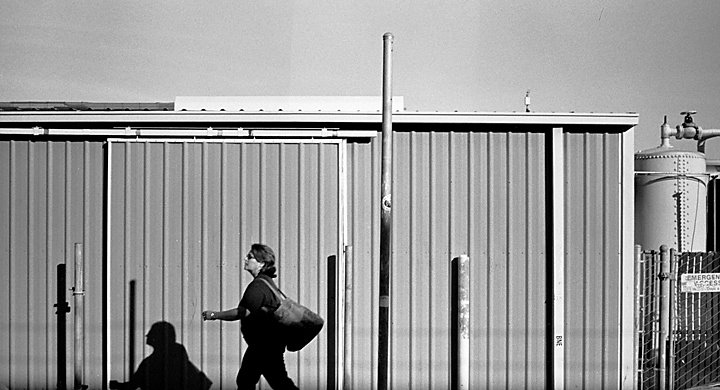
Busy, busy, busy, lately, but I'm carrying the Hexar with me and shooting regularly. Here's another Hexar AF image:

click to view larger
Hexar AF, Tri-X


I got a chance to mix up some developer, so I'll have other more recent images from my outings with the Hexar to post very soon.

Here's a teaser for you: I picked up another point & shoot camera. I'll divulge what that camera is and post some images in another post. I hope you are enjoying the summer. Get out and shoot, shoot shoot.

Friday, June 09, 2006

The Color Coordinated Scene 2

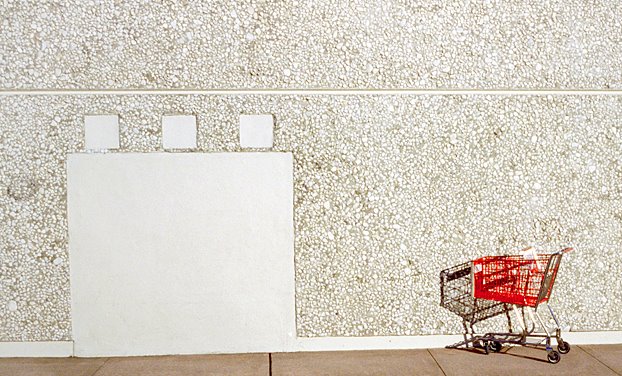
The color-coordinated scene, I've written about them in a previous post, and posted a picture. Here's another.

It's not tidy, and it's a little ragged around the edges, but I kind of like that.

Hexanon 35/2, Kodak 400 HD

Thursday, June 01, 2006

Hexar AF Results

Hexar AF Tri-X


I recently acquired a black Hexar AF (with silent mode). I'm just getting the hang of it, and still getting used to using it. I plan on shooting a lot with this camera in the coming months, so I'll be reporting on and reviewing the camera. If you're interested in this camera you can get some great information at CameraQuest's excellent Classic Camera Profile page, and specifically the Hexar AF page.

Wednesday, May 31, 2006

Diane Arbus and a Civil War Re-Enactment

I ended up at a Civil War re-enactment last Sunday. I was never big on the idea Civil War re-enactments, or period re-enactments for that matter, but I made a promise to myself that I would try to be open-minded, especially when it comes to photography. I'm trying to maintain the idea that anywhere can be a photo-op, and before I react with a "not interested," when propositions, invitations, suggestions arise, I immediately try to look at not only the photographic possibility, but the learning potential as well.

I think it’s important to let your photography be a vehicle for learning, for stretching your range of experience. What is interesting is that if you venture out with an open-mind, into the unfamiliar, the uncomfortable, you will inevitably come away with having learned something, with a new appreciation, or with a different perspective.

This attitude can guide us toward some unforgettable experiences and (hopefully) some wonderful photographs. It worked for Diane Arbus. My favorite Diane Arbus quote is from the first line of her famous Aperture monograph:

"My favorite thing is to go where I've never been."

I've always loved how this quote opens her book, a book of work that is a journey, for both the viewer and the photographer, away from the normal, and out to the fringes. It’s a great attitude for a photographer to have, and one that even the lowest rank of us amateurs can adopt and put to use.


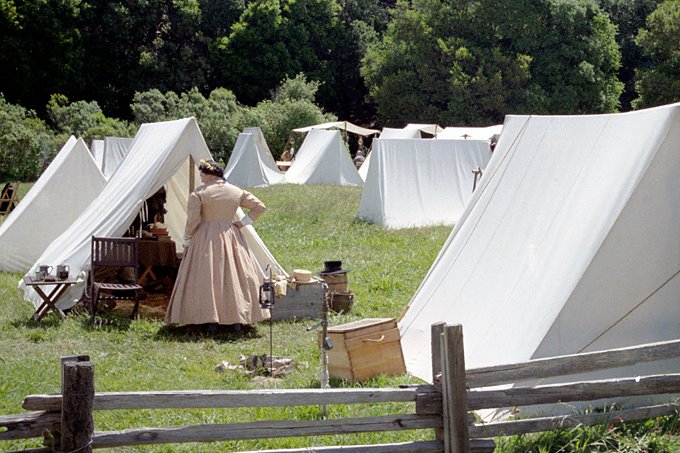
I agreed to go to this re-enactment, primarily because it was a Sunday family trip, and also because the real purpose of the family trip was to ride a train through an old growth redwood forest. The re-enactment was just an OBTW happening ocurring on the grounds of this place called Roaring Camp Railroads. I figured I could make a challenge out of it, by doing something photographically different, but I ended up being surprised.


While the train ride was very nice, and a little less than I expected, I have to say that I was very impressed by the re-enactment, particularly the battle scenes (and the canons!). The level of detail and authenticity displayed by the participants also impressed me. They played the part very well, with a consistency that surprised me. For instance this fellow...


...was instructing my daughter on how a man and a woman, back in the 1800's, would hold hands while in public. It was all about showing respect for the woman, and taking care of reputations and appearances. Coincidentally, we later came across this couple:


Now, I swore to myself I wouldn't take pictures like this, but I had to take this one, because a photographer (not me!) was badgering this couple. This photographer had a big ol' DSLR (of course) and was trying to get this fellow to put his arm around the girl and hold her closer to him, but this guy wouldn't do it. He kept saying that his “…father would get mad at him." The photographer wasn't buying it and was getting pushy, but I knew why this guy would not put his arm around the woman. He was playing the part, and there was no way someone was going to catch a picture of him not playing the part. He never did it, and the photographer waved them off and walked away. That level of commitment and dedication to authenticity impressed me. It was something that I found from all of the participants, who actually camped in the park in these little white pup tents. This was serious business to everyone, and that commitment deserved some degree of respect.

All in all it was fun, and I would encourage all of you out there to try to see, not just the photographic potential of a place, or a happening, but also the educational potential and enlightenment (however small) that your photographic pursuits can bring you.

Here are a couple of shots that I'm happy with.


I took two cameras with me. This one, the Konica Hexar AF, had color film (Fuji Superia 200). I’ve several rolls of black and white that once I develop, I’ll post if they’re interesting.

Saturday, May 27, 2006

Tuesday, May 23, 2006

90mm Comparison


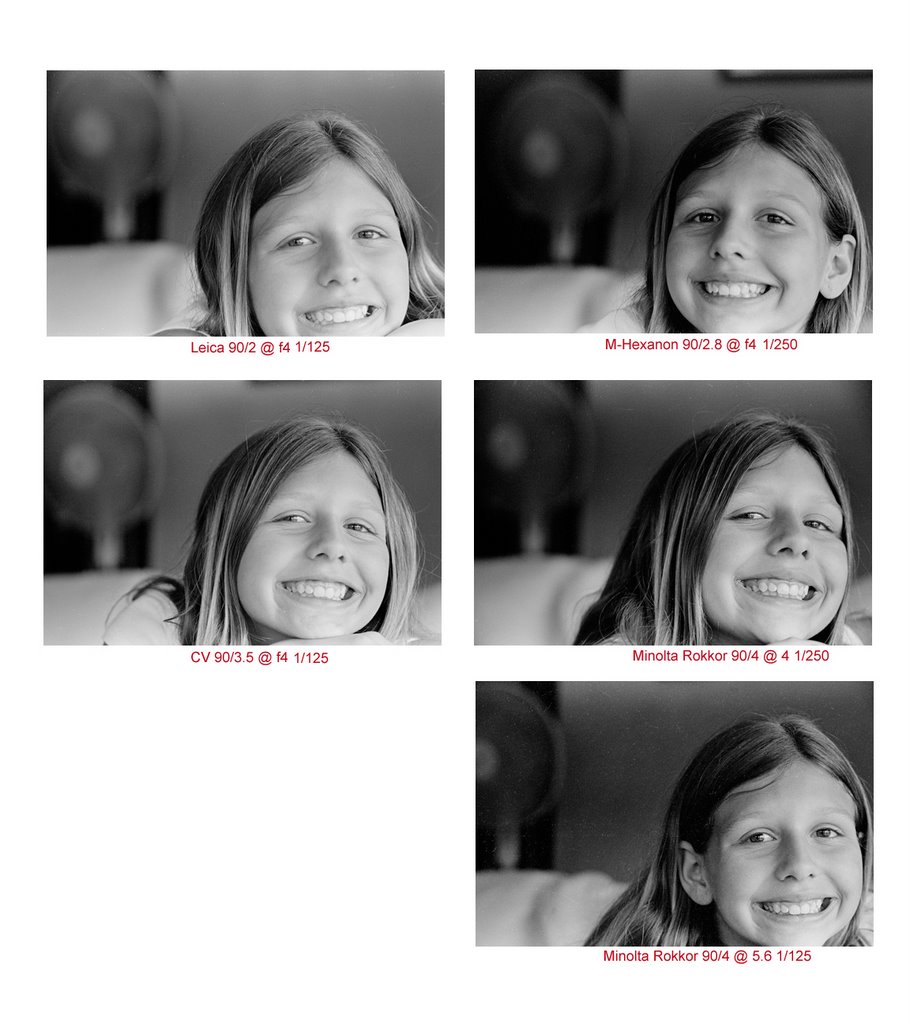
The 90mm lens comparison is in. Pictured above is the sheet depicting the lenses stopped down one from wide (f4). For the other two sheets and more details (and responses) click Here to go to the rangefinderforum thread.

The lenses pictured above (click to see image larger), starting from the top left and going clockwise, are Leica 90/2, M-Hexanon 90/2.8, Minolta Rokkor 90/4, Minolta Rokkor 90/4 (again, but at f5.6—one stop down from wide) and the Cosina Voigtlander 90/3.5. The film is Tri-X developed in D76 1:1.

Monday, May 22, 2006

90mm


I've been shooting a lot with the 90mm focal length. The 90 isn't the most common/practical length, but I've found that I'm using it more and more. I've primarily been using my 90/2 indoors at my kids' karate classes, as well as to shoot portraits.

This image was shot using a Minolta Rokkor 90/4 and Tri-X film. I catergorize this shot as a portrait.


I shot a 90mm test using my three 90's, and as soon as I'm done processing the film, I'll post it up either here or on RangefinderForum.com. If all goes well, I'll post sometime this week.

Friday, May 19, 2006

The Day the Light Got in the House

This strange afternoon light made its way onto the wall, reflected off the countertop; it invaded through the kitchen window, and like a bird in a house, maniacal, confused, it found a safe perch, and rested, and waited.

Saturday, May 13, 2006

CaliGirls


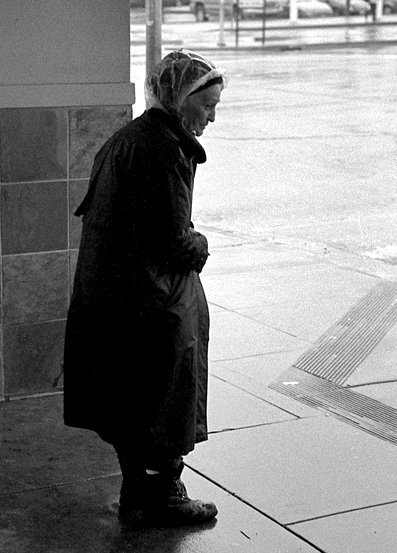
I'm appearing a bit like a voyeur here, but actually this was the first shot after a roll change. I looked up after changing the roll, put the camera to my eye, focused and clicked off several exposures. These California girls heading out to the mid-morning surf happened across the frame. This was the first clean exposure. You're looking at Tri-X shot through a CV 35/1.7
Friday, May 12, 2006

The Giant Camera

On the western most edge of the city and county of San Francisco sits the Giant Camera.


The Giant Camera is actually a camera obscura, a walk-in pinhole camera and minor tourist attraction. Visitors to the Cliff House will find the Giant Camera ensconced on the lower back deck, close to another minor tourist attraction, Seal Rock. The Giant Camera doesn't fit the decor of the rather modern looking Cliff House retaurant. The camera's design is really almost tacky, but it is loved by San Franciscans.

The experience of being inside the Giant Camera is magical. Several visitors at a time enter the camera through the front doors and find a position around a central viewing area. Once inside a guide closes the doors, and the visitors suddenly find themselves in a very dark, very quiet space. They wait in the for their eyes to adjust to the dark with nothing but the sound of the Pacific and their whispers and giggles.

Allowing for the adjustment, the guide then opens the aperture, which is located on the pyramid-shaped structure on top of the camera, and an image of the Pacific Ocean magically appears on a horizontal surface in the middle of the room. The guide can rotate the aperture to provide different views of the ocean, and even Seal Rock.


Most tourists and visitors seem underwhelmed by the experience. Afterall, there's a much better and realistic view just outside the door, but for anyone who has ever been remotely serious about photography the Giant Camera is wonderful, pure magic.

Friday, May 05, 2006

Spiazzo

This is a place called

Spiazzo

Fuji Superia 400

Wednesday, May 03, 2006

Mood Light

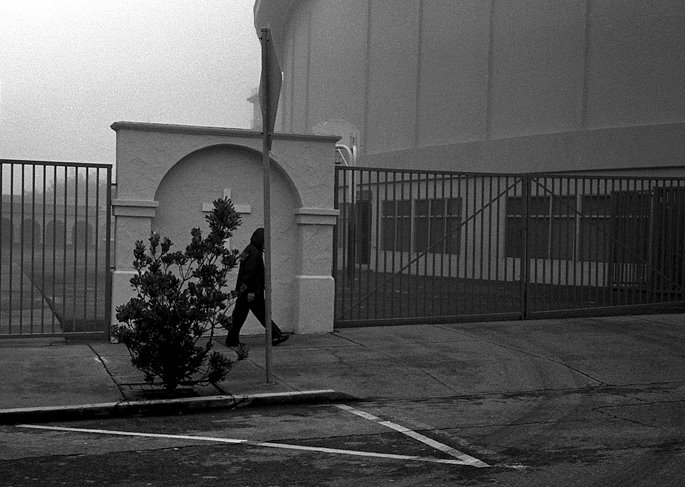
Not a very cheery image; I know. The fog will do that. This type of light presents a challenge. It seems to have a built-in mood and seriousness to it.


Tuesday, May 02, 2006

What's Your Summer Photo Project?

What's your summer photo project? I was asked this the other day, and even though I had a well thought out answer, I've always considered everything I shoot as a a shade of the one major project that we create over and over. Filmmakers make the same film, musicians write the same songs, painters paint the same painting, photographers make the same photograph. However, when we first choose a meaningful project it is a personal show of confidence, a sign that we are beginning to look at our work seriously, and (God forbid) take ourselves seriously.

I think projects are a good thing, especially when they are created in response to a concept, or an ideology. I love how Walker Evans' conceived his subway project, the work which eventually became the book, Many Are Called. The project idea arose from a strong ideological reaction to classic studio portraiture. Evans' felt compelled to create the antithesis of the studio protrait, and set about on his masterpiece. IMO, the result was very successful, a beautiful and fascinating body of work. To me this is the absolute best approach for a project. The desire to shoot cohesively should be driven by a greater need.

The wrong approach is one wherein the photographer seeks to handicap himself as a means of improving his "skill." Such projects usually entail the photographic equivalent to walking around for three days with your right leg tied back, in the hopes of improving the strength of your left leg. For instance, shooting strictly with a particular focal length, shooting only images within a one block radius of your front door, shooting only things that are the color red, are all handicap-based projects, especially when set about so simply.

For me, a self-imposed project should be an opportunity for discovery, or enlightenment, and it should be something that needs be written down. It doesn't need to be thematically grand, or ideologically driven. It can be driven by emotions and desire, but it should be purposeful and multilayered. For instance, it's one thing to want to photograph the simple beauty and the majesty of an old-growth redwood forest, but to set out to want to explore and convey, along with that beauty, the mysterious and mystical, or a sense of age and time, is taking the project to another level, a level that will challenge the photographer. By adding this additional layer the photographer adds a degree of measurability to the project that will help to determine whether the photographer was successful, or not.

The success of the project is ultimately determined by the viewer, so while a project can be a personal endeavor (and there's nothing wrong with shooting strictly for oneself), the feedback is invaluable, and any serious project should take into account the viewer, or the audience.

I hope to announce the completion of my summer project(s) here, and if anyone else is planning a summer project, and is posting online, and would like someone to view and provide feedback, I'll gladly help out in anyway I can.

Saturday, April 29, 2006

Wednesday, April 26, 2006

Untitled Places

In an attempt to put some "form" to my pBase gallery, I regrouped my current work. My favorite new gallery is the one called This Place Has No Name.


This gallery groups together of all my recent images of places that have intrigued me into taking their picture. I do a lot of shots like this.


They typically don't get a lot of attention when I post them online, but I don't care. I'm really enjoy them and enjoy seeing them grouped together. It's like they have a cause now, a raison d'etre.

Sunday, April 23, 2006

US 101


Here's a very small section of US 101, the big gnarly freeway, a portion of which serves as a pipeline up and down the peninsula from San Francisco to San Jose. US 101 follows the entire contour of the western edge of the San Francisco bay. The well worn strecth of US 101, between the two cities, is unremarkable, and ugly, a utiltarian patch of concrete and tar, that is both, hated and cursed, and absolutely necessary.

Bumper-to-bumper at 80 MPH, the passing traffic kicks up dust and trash, the flotsam and jetsom of life, hubcaps careening, spearing toward the shoulder, rubber melting, oil spraying, and billboards.


Tri-X in FX15

Friday, April 21, 2006

Closer

With the weather being the way it's been here on the west coast, I find I turn inward, inside, when I can't go outside. So, when inside, when I want to photograph, I look at things closely, closer. How convenient for me, then, that I recently acquired a macro lens, a Nikon 55/2.5, for my Nikon SLR. The timing was good.


If you've visited here before, you're probably well aware that I'm not a flower photographer kind of guy. So...


Here's a shot of some rotting berries!

When I look at these images, I realize just how much I enjoy shooting film. It'll be a sad day when we're no longer able to shoot film...I'd rather not end this post on a down note, maybe on a dark note:


Thanks for visiting!


Nikon FM3A Nikkor 55/2.5 Kodak 400UC, Fuji Superia 400

Wednesday, April 19, 2006

A Bridge (to cleanse the palate)


The San Francisco/Oakland Bay Bridge from Treasure Island. This shot depicts San Francisco's notorious summertime afternoon fog as it sweeps in over Twin Peaks and Sutro Tower.

Saturday, April 15, 2006

Looking For Purple


~Click to see larger~

I sought something purple, but found nothing. I sought something "meaningful," and found this. An image for the weekend.

Minolta CLE, CV 28/3.5, Tri-X

Wednesday, April 12, 2006

My Better Half

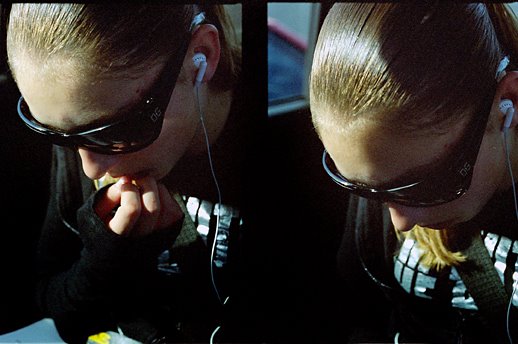
It must be half-frame time. Oscar, publisher of Single Coated (the photoblog) posted a delightful half-frame image on his blog, at about the same time I had taken to carrying my Pen Ft with me again. His image inspired me to actually attempt to finish the 36 exposure roll of Kodak 400UC I had trapped in the camera.

The half frame camera is a really wonderful and different format. It is the analog equivalent of the digital point & shoot. At 72 exposures/36 exposure roll, there's really no holding back. Armed with a half-frame SLR, anything and everything is fair game. Shooting with my Olympus Pen FT, and its double-stroke film advance, makes me feel like some 1970's hipster revelling in his cutting edge state-of-the-art doofus gear.

Printing half-frames normally usually results in images like the ones below.


Sure one could scan and size the individual "frames," but the side by side look is so inherently "cool"—like two frames from a 16mm movie, that breaking up the pairings is too hard to do.


Everything takes on such an unusual and cinematic look.

If you're interested in seeing some other photographers who shoot half-frame, check out Keith Goldstein there on pbase and on RFF as Kbg32.

Thursday, April 06, 2006

RJ

The Summicron 50/2 is a wonderful lens, a joy to use.


Here's a shot of my son. I love the glow and the bokeh exhibited by the lens. The lens and the boy are both beauties.

Leica M camera, Summicron 50/2, Fuji NeoPan 400

Monday, April 03, 2006

Railyard Outing

I was invited to shot this last weekend with a group of local photographers, some of which are RFF members. It was a great excursion to San Francisco's railyard for old streetcars. The city maintains a "collection" of the cars.

I shot with both color and black and white. Here are some of the early results, a first whack really.


If interested, look HERE for more images.


A special thanks to Allan (Kaiyen on RFF) for putting this offer to shoot with his photo group out to local RFF members. I'm really glad I was able to come along.


I usually shoot alone, so this was interesting.


Details: Kodak 400 HD, Leica M4-P, M-Hexanon 28/2.8

Monday, March 27, 2006

The Haunting

Last September, I screwed up this roll, and it haunts me to this day. The roll (and two others) represent about 3-hours of effort while shooting at a street fair, on a day when everything seemed so right, seemed to 'click' (pardon the pun). This was one of those rolls that I knew had some interesting shots. One of those rolls that photographers rush to process, and then pull out of the fixer at the earliest possible second, to view the results.

I accidently processed this roll in partially exhausted developer, and when I pulled it out from the fixer, I knew it immediately. At the time I was thankful and hopeful, because the developer had at least partially processed the roll(s).

In hindsight, however, I would rather have had the roll completely destroyed, because I can see the images, the compositions, and I know I had some decent shots.


The one above is about the best I can pull out of the roll with this scan and scanner. I recently picked up a new scanner, so I'll probably give the roll one more effort. I'm still hopeful.

BTW, I've not made the same mistake again.

Wednesday, March 22, 2006

Rangefinder Photography Book 2 Available Now


I'll take a little time to announce that the Rangefinder Photography 'A Gathering' is available from Lulu press HERE. This is the second book from the membership at RangefinderForum.com (RFF). BTW, the first book is also available from Lulu and currently sits on the publisher's Top 100 list.

'A Gathering' is a collection of images taken with rangfinder cameras. Ninety-seven (97) international photographers contributed 2 photographs each to the cause, providing a biography, photo titles & descriptions, and technical data.

On RFF a question arose regarding "who did what" on the project. I'll try to define that here. The book was created by a team of 5 RFF members. I am happy to have been a part of that team. While the "responsibilities" within the team, were defined, they were never strictly the province of any one member. Any and all decisions were discussed thoroughly by the team. The broad general roles fell something like this:

I, 'RayPA' (Ray Angelo) worked on compiling and editing the back-of-book information (bios, image descriptions, tech data).

'back alley' (Joe Rizzuto) a moderator at RFF, as well as a poet/photographer, wrote the dedication, and represented the membership of RFF throughout the behind-the-scenes process.

'Joe Friday' (Brett Solberg) worked within the "restrictions" of the first book's layout & design, and found a truly unique look for book 2. Brett basically laid out the entire book. He also compiled and managed images, applied the necessary sharpening, designed the covers and just about everything else having to do with the look and feel of the book.

'Rover' (Ralph Meliso) was essentially the team leader/project manager and editor. He held and managed the deadlines and submissions. He also acquired the permission necessary for the use of the essay (the winning essay from a RFF contest), gathered and compiled information, chased down missing information, vetted the final document.

'GeneW' (Gene Wilburn) was part of the initial project design and conception, helping to provide direction for the project.

'A Gathering' looks very nice, and is a nice acompaniment to the first book. While the first book had 25 photographers, two images each, 'A Gathering' took any and all comers who responded and made the deadlines.

We've an excellent collection of images and some real talent both here in this book and at the RFF gallery. If you get the chance, check out both.

Wednesday, March 15, 2006

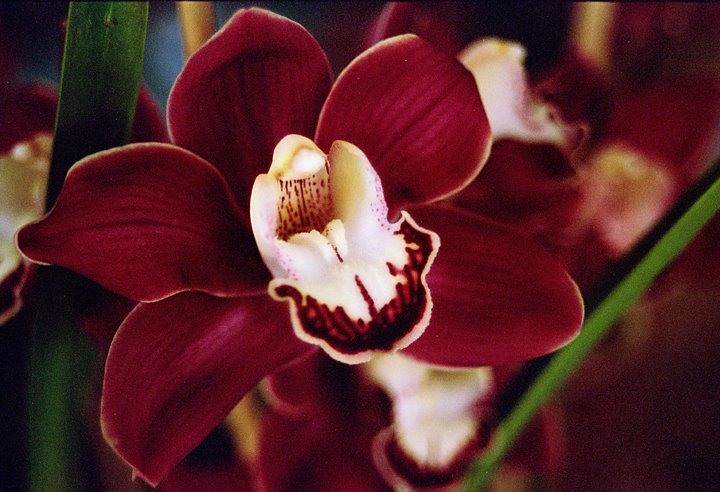
From the San Francisco Orchid Show


I'd never been, and was amazed at the passion surrounding these plants. People are fanatical about orchids, which is fine. Everyone should feel passionate, or fanatical, about something (guess what I'm fanatical about).


Plants were put up for display and lit up with lights, and affixed with ribbons and claims of "Best," "Runner-up," "Honorable Mention," etc. People with macro lenses on their cameras, and soft flashes, crowded around the winning entries like they were Hollywood stars.


I came totally unprepared with black and white film loaded in the camera, intent on shooting the periphery, the people. I felt compelled to "look the part," and snap a few shots of these strange little beasts. It's odd. I don't consider them flowers at all, because hearing stories about how and why some of these plants evolved into their existence was fascinating, weird, and seemed almost willful on the part of the plant, almost devious, intelligent. That's kind of creepy, cool, but creepy.


In the end, we came home with several new housemates. They're beautiful, but they're still not flowers to me.

And now for us fanatics: images caught with a Leica M4-P, Summicron 50/2 lens, Tri-X.

Tuesday, March 07, 2006

Phat Plus-X

Can film type affect your shooting style?


Lately I've been reveling in Plus-X, and all its glorious mid-tones. It's gotten to the point where I end up close to a flat (low contrast) image, because I concentrate so much on those fat middle tones.


So, with my 100' roll of Plus-X I've been inspired to search out those tones. I find myself pointing my camera at sticks and stones, which is not what I like shoot, but the above image gives me a little faith that I can embrace Plus-X for shooting on the street.

Friday, March 03, 2006

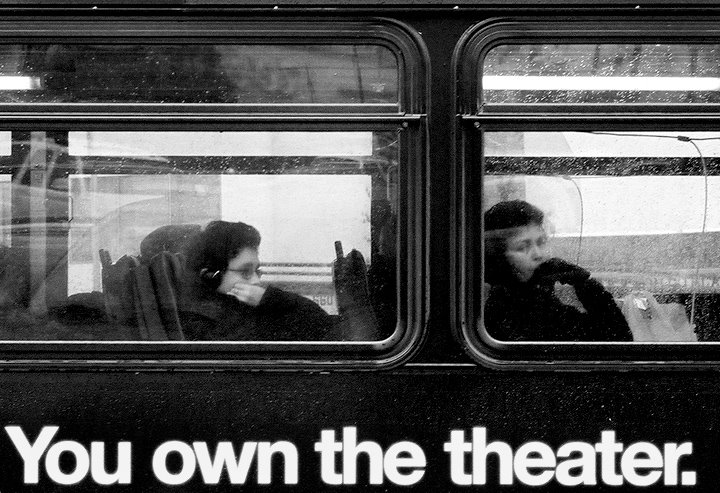
You Own the Theater


You own the stage, the players, the script, the responsibility, the theater.