Monday, March 27, 2006

The Haunting

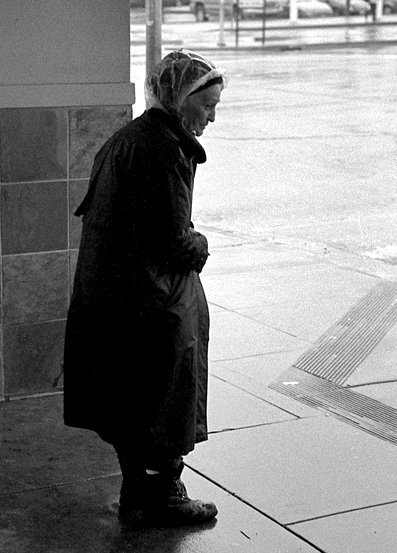
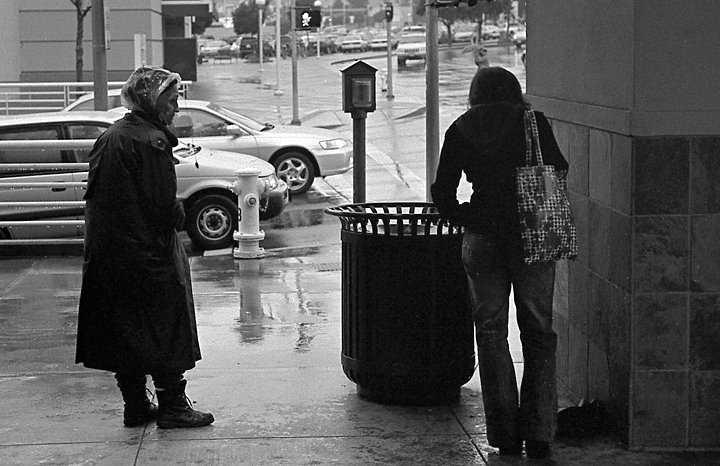
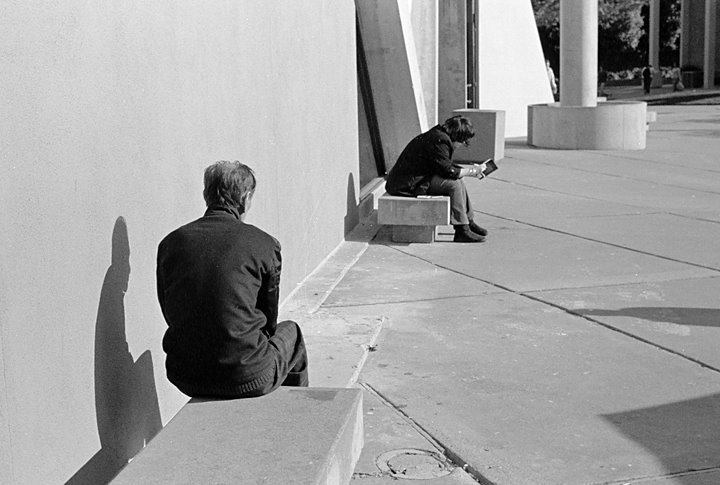
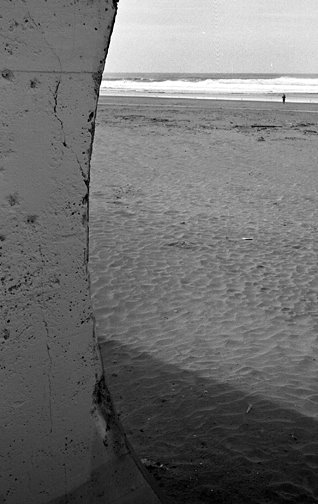
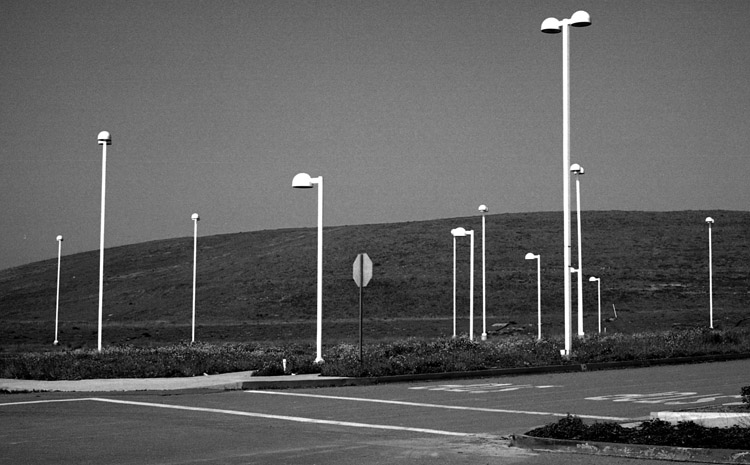
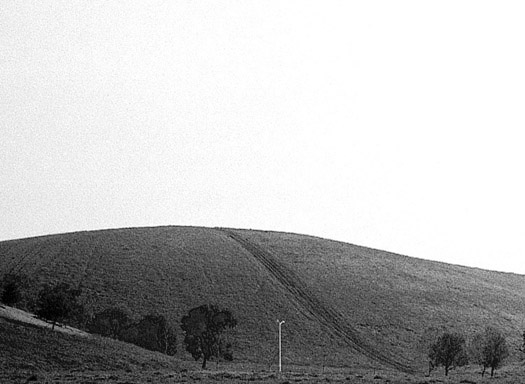
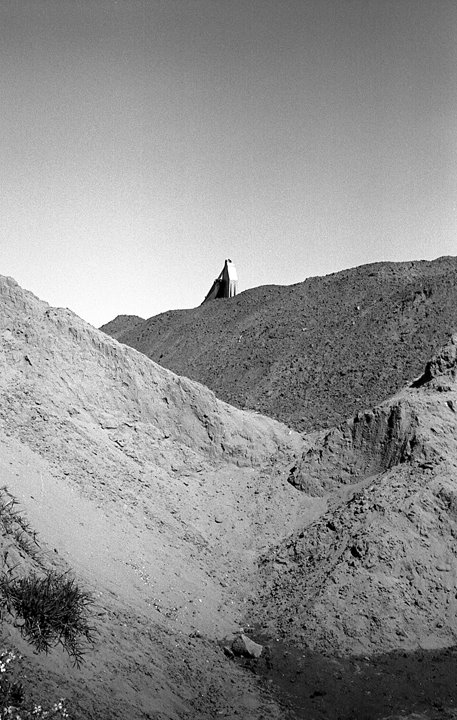
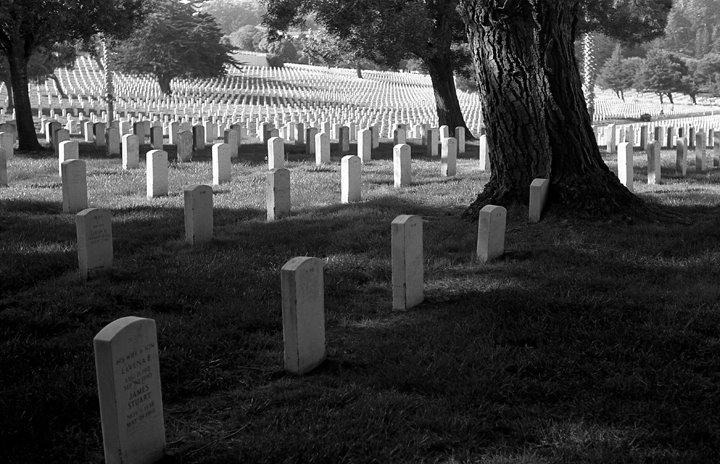
Last September, I screwed up this roll, and it haunts me to this day. The roll (and two others) represent about 3-hours of effort while shooting at a street fair, on a day when everything seemed so right, seemed to 'click' (pardon the pun). This was one of those rolls that I knew had some interesting shots. One of those rolls that photographers rush to process, and then pull out of the fixer at the earliest possible second, to view the results.

I accidently processed this roll in partially exhausted developer, and when I pulled it out from the fixer, I knew it immediately. At the time I was thankful and hopeful, because the developer had at least partially processed the roll(s).

In hindsight, however, I would rather have had the roll completely destroyed, because I can see the images, the compositions, and I know I had some decent shots.


The one above is about the best I can pull out of the roll with this scan and scanner. I recently picked up a new scanner, so I'll probably give the roll one more effort. I'm still hopeful.

BTW, I've not made the same mistake again.

Wednesday, March 22, 2006

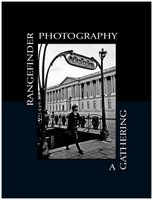
Rangefinder Photography Book 2 Available Now


I'll take a little time to announce that the Rangefinder Photography 'A Gathering' is available from Lulu press HERE. This is the second book from the membership at RangefinderForum.com (RFF). BTW, the first book is also available from Lulu and currently sits on the publisher's Top 100 list.

'A Gathering' is a collection of images taken with rangfinder cameras. Ninety-seven (97) international photographers contributed 2 photographs each to the cause, providing a biography, photo titles & descriptions, and technical data.

On RFF a question arose regarding "who did what" on the project. I'll try to define that here. The book was created by a team of 5 RFF members. I am happy to have been a part of that team. While the "responsibilities" within the team, were defined, they were never strictly the province of any one member. Any and all decisions were discussed thoroughly by the team. The broad general roles fell something like this:

I, 'RayPA' (Ray Angelo) worked on compiling and editing the back-of-book information (bios, image descriptions, tech data).

'back alley' (Joe Rizzuto) a moderator at RFF, as well as a poet/photographer, wrote the dedication, and represented the membership of RFF throughout the behind-the-scenes process.

'Joe Friday' (Brett Solberg) worked within the "restrictions" of the first book's layout & design, and found a truly unique look for book 2. Brett basically laid out the entire book. He also compiled and managed images, applied the necessary sharpening, designed the covers and just about everything else having to do with the look and feel of the book.

'Rover' (Ralph Meliso) was essentially the team leader/project manager and editor. He held and managed the deadlines and submissions. He also acquired the permission necessary for the use of the essay (the winning essay from a RFF contest), gathered and compiled information, chased down missing information, vetted the final document.

'GeneW' (Gene Wilburn) was part of the initial project design and conception, helping to provide direction for the project.

'A Gathering' looks very nice, and is a nice acompaniment to the first book. While the first book had 25 photographers, two images each, 'A Gathering' took any and all comers who responded and made the deadlines.

We've an excellent collection of images and some real talent both here in this book and at the RFF gallery. If you get the chance, check out both.

Wednesday, March 15, 2006

From the San Francisco Orchid Show


I'd never been, and was amazed at the passion surrounding these plants. People are fanatical about orchids, which is fine. Everyone should feel passionate, or fanatical, about something (guess what I'm fanatical about).


Plants were put up for display and lit up with lights, and affixed with ribbons and claims of "Best," "Runner-up," "Honorable Mention," etc. People with macro lenses on their cameras, and soft flashes, crowded around the winning entries like they were Hollywood stars.


I came totally unprepared with black and white film loaded in the camera, intent on shooting the periphery, the people. I felt compelled to "look the part," and snap a few shots of these strange little beasts. It's odd. I don't consider them flowers at all, because hearing stories about how and why some of these plants evolved into their existence was fascinating, weird, and seemed almost willful on the part of the plant, almost devious, intelligent. That's kind of creepy, cool, but creepy.


In the end, we came home with several new housemates. They're beautiful, but they're still not flowers to me.

And now for us fanatics: images caught with a Leica M4-P, Summicron 50/2 lens, Tri-X.

Tuesday, March 07, 2006

Phat Plus-X

Can film type affect your shooting style?


Lately I've been reveling in Plus-X, and all its glorious mid-tones. It's gotten to the point where I end up close to a flat (low contrast) image, because I concentrate so much on those fat middle tones.


So, with my 100' roll of Plus-X I've been inspired to search out those tones. I find myself pointing my camera at sticks and stones, which is not what I like shoot, but the above image gives me a little faith that I can embrace Plus-X for shooting on the street.

Friday, March 03, 2006

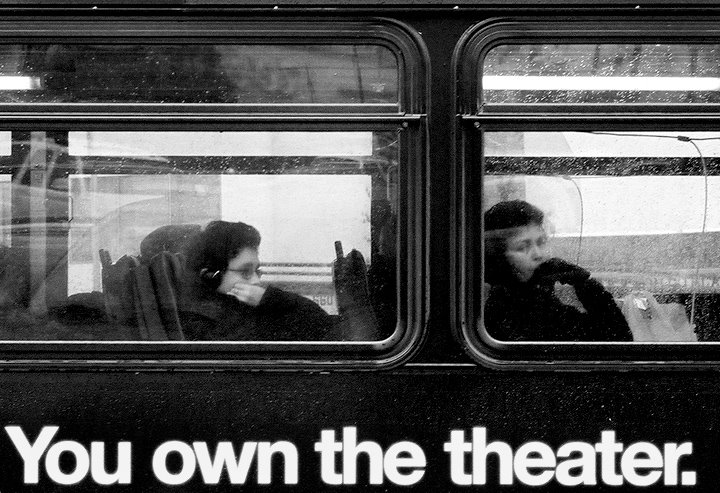
You Own the Theater


You own the stage, the players, the script, the responsibility, the theater.

Sunday, February 26, 2006

Once Upon a Time

One story.

Once upon a time,


The End.

Tuesday, February 21, 2006

A fast single-coated lens shot in full sun, what's that like?

I like fast lenses, even though I may rarely shoot near-total darkness. I like having the capability on the wide end to reach into shadows and pull out detail. My bias towards fast lenses comes from my days as a photography student, when the only camera I had to shoot with was a YashicaMat 124. It had a very good lens, but I was constantly bumping up against that f3.5 limitation. You couldn't have convinced me back then that 3.5 wasn't slow.


So here are some images, shot with the same CV 40/1.4 SC used in the previous post, in full sun, unfiltered (no UV either), on Tri-X, and processed with a solvent developer, designed to be similar to D76, but to give about a 2/3 stop speed increase over D76.

Tuesday, February 14, 2006

40/1.4 Nokton SC

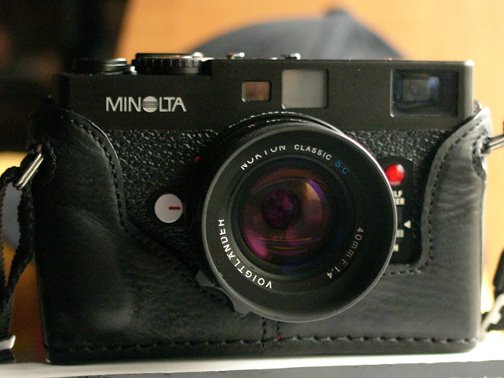
A recent acquisition from Cosina Voigtlaner, the 40/1.4 Nokton SC, is the single coated version of the 40/1.4 Nokton (multi-coated). I've been wondering about this lens for a while, so when I acquired it, I immediately slipped onto my CLE, with its convenient 40mm framelines, and hit the streets for a test roll, or two.


I'm not lacking for a good 40mm lens. I own the M-Rokkor 40/2, which is very nice, but the single-coated version of the Nokton, with its reputation for being a good lens for shooting black & white was too much to bear.


Reports on this lens have been mixed. It reportedly has inferior bokeh. I'm not a bokeh chaser, but a lens that exhibits quality out-of-focus areas is very pleasing.


I own the Konica Minolta Hexanon 50/2, which IMO, has excellent bokeh.


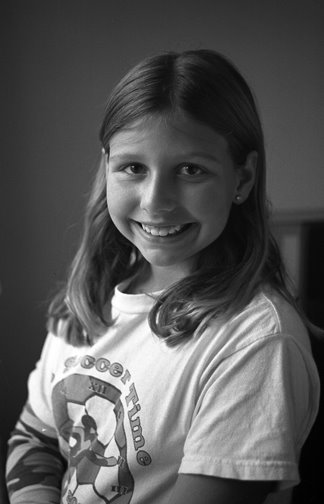
What you're looking at here, are images from the single-coated Nokton, from the first two rolls, in fact. I've not been able to form an opinion, but the lens seems to have a look considerably different from the CV lenses I own. For example, it is completely different from the 35/2.5 and 28/3.5 and closer to its sibling the 50/1.5. I particularly like the midtones as rendered by the 40/1.4, the skin tones on the portrait, and the tones on the basket and face of the woman, in the image above.

I'll post more as they come in. The film types here are PlusX and TriX.

Sunday, February 12, 2006

California

Three impressions of the place I love, California.


Three views of my California


It seems the camera can make strangers of friends, family, and places.


Enriching that relationship.

Monday, February 06, 2006

Waving Beauty


Summer 2005.
Minolta CLE, Cosina Voigtlander 28/3.5, APX 100

Wednesday, February 01, 2006

An Image


This is a favorite image of mine. If I remember correctly, it was shot using a CV 90/3.5 APO Lanthar. For me, sometimes, a favorite image, becomes a favorite image for reasons beyond the visible. This image is nothing special, really, but it carries a lot of memories with it, tangible, sensual ones.

Tuesday, January 31, 2006

A Passion

One thing I like as much as taking photographs, making images, fondling gear, and playing in the “darkroom” with film and developer combinations is looking at the work of other photographers, especially, but not exclusively, those from photography’s long and varied past. I love photography books, and I’m always perusing online booksellers, and getting ideas from places like photoeye.com, which sends out “New Arrival” and “Sales” emails, on a regular and frequent basis.

Books are a passion of mine, but looking at and studying photographs, seems to be a deeper subset of photography, a link not common to us all, existing beneath metal, glass, and film. I’m always offering books of photographs to my loved ones and friends, only to have them give it the obligatory flip-through, and hand it back, which is understandable from those who aren't as immersed in photography, but I’m always surprised by the lack of discussion (or even mention) on online forums of photography books and the work of published photographers (beyond the occasional worship paid to Cartier-Bresson, and Winogrand). I’ve my thoughts on why this is, but I’d rather not expound upon them now. Instead, I’d rather offer up to you the work of Stephen Shore, and the republished ‘Uncommon Place—The Complete Works.’

If you enjoy work in the street photography lineage, particularly, as the liner notes state, the work of Robert Frank and Walker Evans, and I would add, right up through Arbus, Winogrand, and Meyerowitz, then you’ll probably like Shore’s work. If you’ve wondered what large format color street photography might look like, then this is the book for you. ‘Nuff said.

Thursday, January 26, 2006

Canon 50/1.8


Here's a shot with the Canon 50/1.8, and below a similar shot (posted here before), taken with the Canon 50/1.4, different film (400 UC above, 400 Superia below), same subject, location, approximate time, but different days. This is a completely unscientific comparison. Both images were shot wide open, the 1.8 with a Canon P, and 1.4 with a Leica M7

Monday, January 23, 2006

Blue Wall—The Color-Coordinated Location


Presented as an example of a "color-coordinated" location, a location, or scene wherein a predominate color scheme prevails, unintentionally, in a serendipitous fashion. I've seen them often, but often they are as hard to catch as a fleeting street shot. I usually see them when driving, rushing across town, unable to stop, promising myself I'll return.

Saturday, January 21, 2006

Canon 50/1.4 Revisited


I posted some Canon 50/1.4 shots last year, around November (I think). Those were color. Here is a black and white test image that just flabbergasts me. Because I have a tendency to shoot in contrasty lighting situations, controlling the contrast, with my modern lense (e.g., Cosina Voigtlander 35/2.5) has been a chore. I usually resort to using some sort of compensating (split developer) to hold it all together. For the most part it works OK.

I had heard that the Canon lenses of old were less contrasty. I also heard that Garry Winogrand used a Canon 28mm lens, with his M4, loaded with TriX. My interest was piqued, and suddenly (quite unintentionally) through a few camera acquisitions, I was in posession of two different Canon 50/1.8 lenses, as well as a 50/1.4.

When I saw this image, shot with a 50/1.4, I was amazed at how well the scene held together, and the image quality, while sharp, contained a softness, evident in the color pictures from the same lens posted earlier. I had shot this scene several times and never had I seen the highlights and shadow detail holding so well, and needing virtually no PS work (a little bump in the blacks was all). I was impressed and wanted to share.

Details: TriX, D23, Canon 50/1.4

Thursday, January 19, 2006

Tuesday, January 17, 2006

Park Anonymous


A very recent picture, taken Sunday, January 15, 2006, at Yerba Buena Park, using a Leica M4-P, Summicron 50/2, Fuji NP400 film (processed in FX15). I submitted this to the RFF photo contest folder. I'm not big on photo contests, but this one intrigued me, because the rules stipulated the use of a "normal" lens for all submitted images (3/photographer), namely a 50mm. The rules also invoked the spirit of Henri Cartier Bresson (HCB), who reportedly shot exclusively with a 50mm. I'm not a big fan of HCB's work (blasphemy, I know), but many of his images made a big impression on me when I was a photography student.

On my first weekend out shooting "for the contest," I took my M4-P, the Summicron 50, 5 roles of film, and my CLE, with a CV 28/3.5 attached. I used the CLE once, to take an OBTW architectural shot. Shooting exclusively with the 50 was fun, and a challenge. Popular opinion states that the 50mm isn't really the normal lens for 35mm film, and that a 35 or a 40 is more what the human eye sees. I've heard the 50 referred to as a "short telephoto." I agree that the 35mm, or the 40mm, is closer to the field of view of the human eye, but I think the 50mm is closer to how the human eye sees and focuses. For some reason, the 50mm is the one lens that really forces me to compose. I find I move around a lot more while composing with the 50. I'm always trying to fit a composition.

If you've never intentionally limited your shooting, try it out. It's really been a lot of fun. I can't wait for the next outing.

Stink Eye


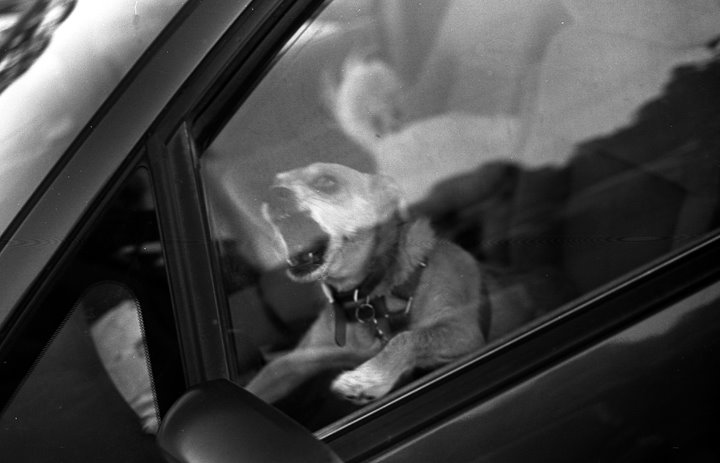
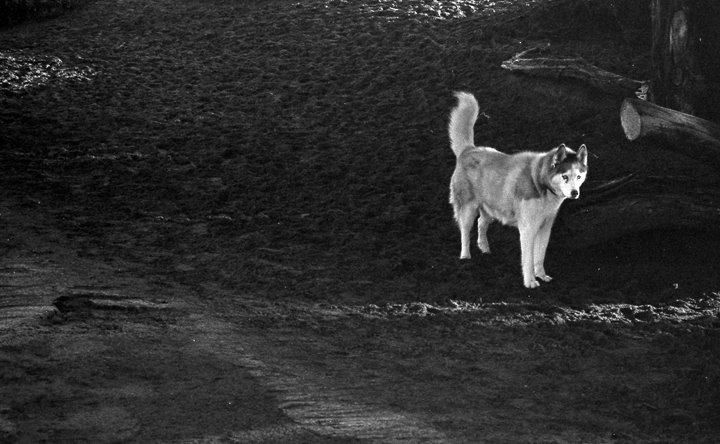
I'm not sure how universal it is to get the 'stink-eye,' which essentially is a dirty look, though far more subtle (funny how dirty looks actually have degrees of severity). I'm getting it here, from a dog. I was honored, and what a better way to honor such a gesture, than to immortalize it with a gesture of my own.

Anyway, this is a roll-ender, one that partially invaded the fully exposed ecstasy of the bulk-loaded tail-end of the film.

Monday, January 09, 2006

Lee St.


I was feeling a bit like Friedlander on this one, not intentionally, but in spirit. I felt very purposeful and driven. I mean I really shot the heck out of this location. I just couldn't find the "right" angle, and I wasn't sure why it was so important, but I kept on shooting. Sometimes you just have to get it out of your system.